By David Scott Smith
In an age of Tivo, iPod, Podcasts, and Xboxes, today’s consumers are turning from traditional media to new forms of electronic entertainment, making them increasingly more difficult to reach through traditional advertising mediums. The challenge that marketers face today is finding innovative — and entertaining —opportunities to connect their brand with their targeted audiences.
A new media vehicle for brand marketing is through the use of advergames. Advergames are custom-developed online video games created specifically for a brand, where the plot and game-play revolve around a featured product or offering. Through word of mouth, offline marketing and online gaming channels, consumers are invited to play these branded games for free. Advergames are typically posted to a special area of an organization’s Web site, and are distributed to consumers through e-mail or accessed from popular online gaming portals. Advergames are quickly becoming a natural catalyst for generating viral advertising opportunities.
Studies show that consumers are willing to enjoy hours of free online gaming entertainment for the small price of experiencing subtle product placement and brand messaging in the context of the game. Many leading brands — ranging from Axe, Coca Cola, Dodge, Ford and Nike — have created their own branded video games, which allow consumers to experience their products through branded entertainment.
The key factor in making a successful advergame is incorporating a brand or product into the game to create a realistic and entertaining situation around the game play. An example of this would be if an automobile manufacturer featured the exact make and model of a SUV in an off-roading game. As players advance in the game, they could update to a higher model SUV and also select upgraded vehicle features. Likewise, a brand-name athletic shoe company could feature a sneaker in a basketball advergame. As players advanced in the game, they could select different models of shoes that would affect their performance and strength of their basketball abilities.
The success of an advergame is easily measured. Because prospect data and contact information is gained from game registration, brands can easily track who is visiting the site, the total accumulated hours of game play, and the number of times a game was referred or e-mailed to a friend — all valuable information to marketers.
Advergames present a tremendous viral branding opportunity for companies to exponentially distribute branded content across a range of audiences. With consumers increasingly turning from traditional media to new forms of electronic entertainment, it’s time for brand marketers to “get their game on” if they want to keep their competitive edge.
Tuesday, 26 June 2007


In-Game Advertising: Get Your Brand in the Game!
By David Scott Smith
Looking for new, innovative methods beyond traditional and online advertising to reach your target audience and increase brand awareness? In-game advertising may be the answer.
According to a Nielsen Interactive Entertainment study conducted in the fall of 2005, television viewership among men ages 18-34 has declined 12 percent, while this same audience spent 20 percent more time with video games. As a result, this highly elusive male demographic has become increasingly difficult to reach, especially through traditional advertising mediums. With market segments turning from traditional media to new forms of electronic entertainment, it’s time for brands to get in the game — literally — if they want to continue capturing audience share.
Unlike television viewers, which tend to be more passive, video game players are focused and actively involved in the gaming experience. Constantly alert and responsive to every element on the screen, gamers are an intensely captive audience. Unlike television advertising, which is often dismissed or ignored by the audience, in-game advertising can actually enhance the realism of the game play, thereby creating a positive connection between brands and consumers.
Companies looking to integrate their brand or products in video games will find a wide range of promotional advertising opportunities, including:
Looking for new, innovative methods beyond traditional and online advertising to reach your target audience and increase brand awareness? In-game advertising may be the answer.
According to a Nielsen Interactive Entertainment study conducted in the fall of 2005, television viewership among men ages 18-34 has declined 12 percent, while this same audience spent 20 percent more time with video games. As a result, this highly elusive male demographic has become increasingly difficult to reach, especially through traditional advertising mediums. With market segments turning from traditional media to new forms of electronic entertainment, it’s time for brands to get in the game — literally — if they want to continue capturing audience share.
Unlike television viewers, which tend to be more passive, video game players are focused and actively involved in the gaming experience. Constantly alert and responsive to every element on the screen, gamers are an intensely captive audience. Unlike television advertising, which is often dismissed or ignored by the audience, in-game advertising can actually enhance the realism of the game play, thereby creating a positive connection between brands and consumers.
Companies looking to integrate their brand or products in video games will find a wide range of promotional advertising opportunities, including:
- Dynamic ad placement — Dynamic ad placement allows for static and video-based ads to be positioned in console, PC, and online games. With the advent of live online gaming, ads can now be tracked and evaluated, offering time-sensitive messaging and geographic targeting, which allows brands to maximize their exposure among their target audience.
- Product placement — Product placement integrates consumer products into the scenery of a game in much the same way products are placed in television and film.
- Situation or plot placement — Situation or plot placement integrates products into the active game play. For example, you might see a vending machine featuring a popular cola brand displayed prominently in a video game, where a player might drink a can of cola to “power up” before completing the next challenge.
- Advergaming — Advergames are interactive games developed specifically for a brand where the plot and game-play revolve around a featured product. Advergames are generally posted to a corporate Web site or distributed through online game channels for download. Advergames are quickly becoming a natural catalyst for generating viral advertising opportunities.
The Streaking Game
The Streaking Game
Your name is Sputter Freesway; and you’re a streaker for hire. Companies hire you to streak at popular events to promote their brand. The longer you manage to run around and get the crowd’s attention with wild stunts (without getting busted by the police), the more you’ll get paid.
 Now get out there and shake your money maker!
Your name is Sputter Freesway; and you’re a streaker for hire. Companies hire you to streak at popular events to promote their brand. The longer you manage to run around and get the crowd’s attention with wild stunts (without getting busted by the police), the more you’ll get paid.
 Now get out there and shake your money maker!
MMOs Set to Grow
If you've been avoiding jumping into the MMO pool, you may not be able to for much longer.
by Daemon Hatfield
by Daemon Hatfield
March 20, 2007 - A report released today by media analyst Screen Digest suggests that massively multiplayer online games (MMOs) are here to stay and are going to become even more popular over the next several years. Titled "Western World MMOG Market: 2006 Review and Forecasts to 2011," the report finds that the MMO market in North America and Europe hit one billion for the first time in 2006.Most of the cash generated from MMOs comes from subscriptions, which account for 87 percent of the market. But new business models like in-game advertising and microtransactions are on the rise, and are expected to slice a bigger piece of the pie in the coming years. In 2006, the North American subscription market hit $576 million, and Europe rose to $299 million. Europe has seen the fastest growth over the last few years, rising from $74 million in 2004, and is expected to see the most growth over the next few, as well.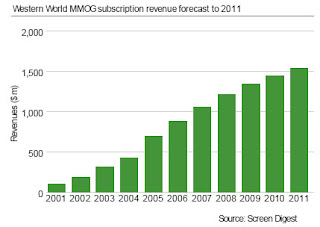
MMO publishers can follow this green staircase to the money pile.
World of Warcraft is still the most popular subscription MMO in the Western market, by far. Blizzard's money-printing machine accounted for 54 percent of the subscription market in 2006 and generated $471 million in revenue. WoW's next-nearest competitor is Jagex's RuneScape, a much smaller-profile game from a boutique developer. Overall subscription revenue in the Western market in 2006 was worth $875 million.

Here's a screenshot from the new Pac-Man MMO.
"During the past few years the Western landscape for MMOGs has become increasingly fragmented following the introduction of new genres of game including social networking, virtual pet rearing, and virtual world building title," says Piers Harding-Rolls, Games Analyst at Screen Digest. "These new games and platforms have brought with them many new gamers and also new business models that are generating revenue that is largely incremental to the incumbent subscription business."By 2011, Screen Digest predicts over 10 million subscription accounts will be generating $1.5 billion in MMO revenue. Germany should maintain the largest amount of subscriptions in Europe, followed by the UK. France is set to see the strongest growth of European countries, growing 15 percent annually, with Spain and Italy both growing by 14 percent a year.Piers Harding-Rolls says, "Growth in the market will be primarily driven by increasing broadband household penetration, increasing penetration of online console platforms, and the continued introduction of more casual MMOG experiences, which are attractive to a wide number of consumers."
BMW pursuit Across Europe

If you thought you had seen everything in Advergaming.
Dont be too sure till you saw this. http://www.bmw-pace.com/pace/
They say its not a game but "The most interesting movie you have seen, and guess what you are playing the lead role" :)
Subscribe to:
Posts (Atom)
